
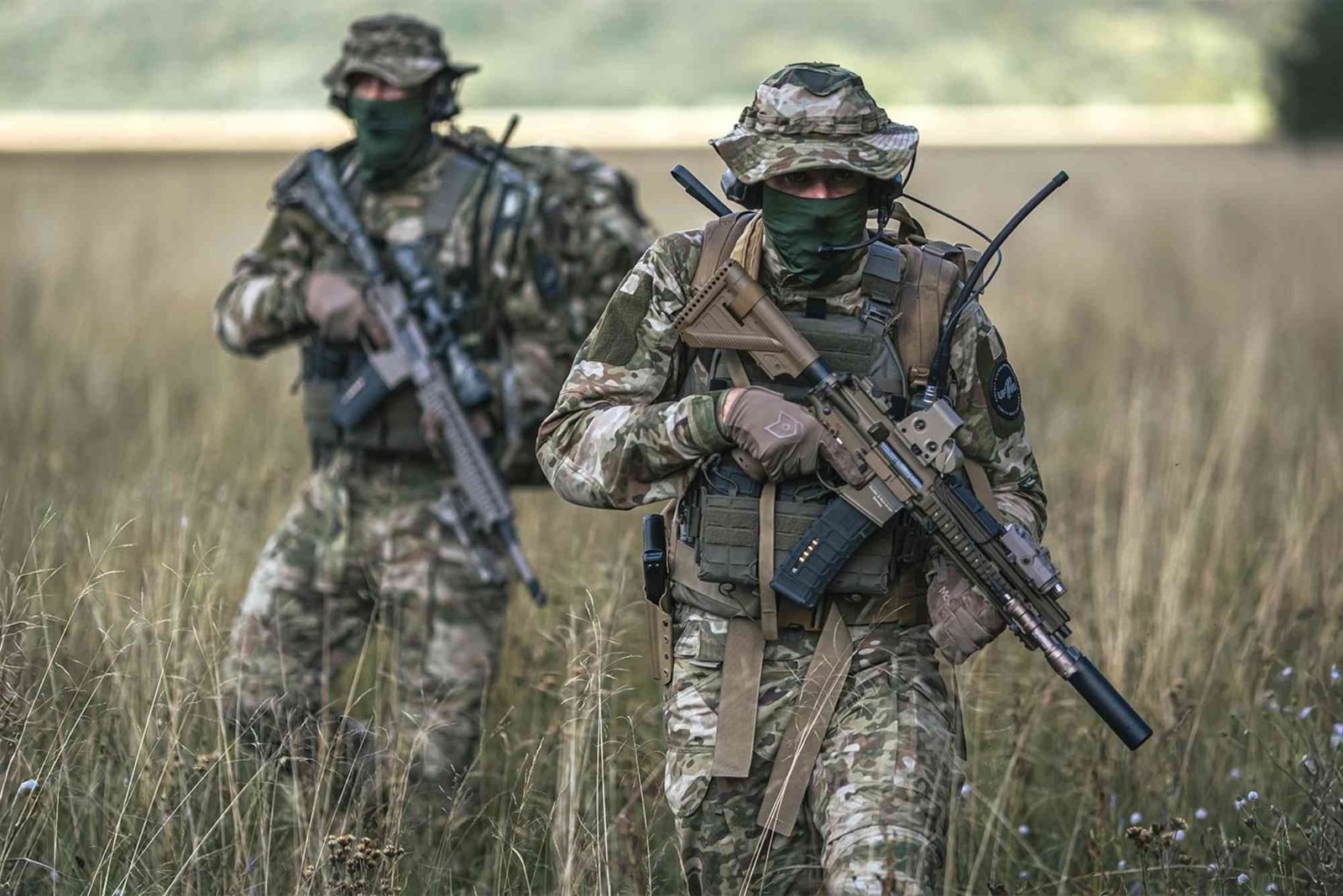
Sniper Rifle Requirements for Jungle Operations, and CARACAL’s Entry into the Fray
When a marksman enters dense jungle terrain, every facet of his equipment is tested: from climate extremes to visibility constraints, from high humidity to rugged mobility. The rifle that works flawlessly on open plains may falter when vines obscure sightlines, monsoons wash the hunting ground, and logistics struggle to keep pace. For weapons manufacturers and armed forces alike, jungle operations pose a unique set of demands—and they have to be met if precision engagements are to succeed.
Enter CARACAL, the United Arab Emirates-based small arms manufacturer and part of the larger EDGE Group defence-technology conglomerate. At the recent LAAD 2025 exhibition, CARACAL showcased its line of precision sniper rifles, assault platforms, sub-machine guns and pistols, and made a move toward Latin America via its newly established EDGE Latin American office in Brasilia and increased investment in Brazilian industry. In doing so, the company has positioned itself to challenge incumbent suppliers—but jungle operations may be uncharted territory for this brand. The question naturally arises: how well can CARACAL’s sniper rifles perform when the engagement zone is a tropical jungle rather than arid desert or urban terrain?
In this article we explore the unique requirements of jungle sniper operations, examine why size, durability and adaptability matter, compare semi-automatic versus bolt-action platforms, and evaluate how CARACAL’s offerings stack up. The goal isn’t simply to sell a rifle—but to ask what it really takes to succeed when the jungle is the battlefield.
The Jungle as a Battlefield: Unique Challenges for Snipers
Jungle environments impose an array of constraints on precision shooters. First and foremost is dense vegetation: thick canopy layers, vines, undergrowth and shifting light make observing, identifying and engaging targets harder. Marksmanship in such zones rarely achieves the kilometric engagements seen in open deserts; rather engagements often occur in 300-500 metre ranges, sometimes less. The heavy foliage also limits line of sight and complicates bullet trajectory estimation.
Second is mobility and terrain: soft soils, waterlogged ground, steep slopes, fallen logs, streams and wetlands force snipers to carry and manoeuvre on terrain that is physically demanding. A heavy, unwieldy rifle becomes a liability when climbing riverbanks or sloshing through swampy ground.
Third: climate and environment. High humidity, frequent rainfall, rapid temperature changes, insect and wildlife hazards, and vegetation that may clog optics or mechanisms all stress the rifle’s reliability. Mud, grit, rust-forming conditions—these show up quickly. Additionally, the logistics chain is often stretched: extraction routes may be narrow or non-existent, resupply may be delayed, so weapons must survive long stints in the field without full armorer support.
Fourth: visibility and engagement tempo. Unlike open plains where long lines of fire dominate, jungle operations often demand rapid target acquisition, sometimes multiple engagements in quick succession, counter-ambush capability, and mobility both in infiltration and extraction. A marksman might witness fleeting exposures of an insurgent or hostile combatant, perhaps only visible for seconds before vanishing into vegetation.
Finally: communication and team support. Dense jungle disrupts radio signals, GPS may be less accurate under canopy, and observation posts may be less static and more mobile. The sniper may have to rely more on instincts, preparation, camouflage, and rapid repositioning.
Given this backdrop, what does the ideal sniper rifle for jungle operations look like? The requirements are stricter than for open terrain—and any manufacturer vying for such a field must meet them.
Key Requirements for Jungle-Optimised Sniper Rifles
Size and Weight
In jungle operations, the marksman is part shooter, part tracker, part survivalist. A rifle must be light enough to carry across difficult terrain and manoeuvrable enough to deploy quickly when a fleeting target appears. A long heavy barrel may deliver excellent ballistics at long range, but it adds length and mass—both disadvantages in jungle. Many armies operating in such conditions prefer lengths near or below 1,100 mm and weights near or under 6 kg for sniper platforms in 7.62×51 mm.
In this context CARACAL’s semi-automatic CAR 817 DMR (chambered in 7.62×51 mm NATO) weighs around 4.96 kg and has an extended length of approx 1,049 mm—placing it on the lighter, more compact side of the spectrum.
Durability and Environmental Resistance
Jungle operations demand that rifles remain reliable despite grime, moisture and lashings of shots without immediate cleaning. Coatings, corrosion-resistant materials, sealed mechanisms, and proven field testing become vital. The debate between bolt-action and semi-automatic emerges here: while many traditional sniper rifles are bolt-action (fewer moving parts, simpler mechanism), modern semi-automatics have closed the reliability gap enough to be viable even in harsh environments.
CARACAL claims its design and manufacturing processes include high quality coatings and material choices, and their rifles (including the CAR 817 family) are descended from models proven in desert warfare—though jungle operations introduce different stresses.
Adaptability and Modularity
Because jungle conditions vary (river crossings, during leaf-litter periods, in monsoon downpours, night insertion, daylight thermal operations), a sniper rifle should offer modularity: adjustable stocks (cheek piece, length of pull, folding/stowage options), accessory rails for optics, night-vision and thermal sensors, quick-change barrels or gas systems, compatibility with suppressed fire if required, and magazine interchangeability. Lightweight deployment racks require quick adaptability rather than permanent configurations.
CARACAL’s rifles support adjustable gas pistons (for suppressed, standard or heavy-use modes), Picatinny/M-LOK rail systems, foldable or telescopic stocks, and compatibility with NATO magazines—features which align with this requirement.
Engagement Envelope and Calibre Trade-offs
Though long-range sniper fire (1,000+ m) is always glamorous, in jungle terrain the effective engagement range is often shorter, maybe 300-500 m or less due to foliage and terrain constraints. Therefore a rifle optimised for jungle may favour slightly shorter barrels (to improve handling) while still delivering sufficient stopping power and precision at mid-range.
Caracal’s CAR 817 DMR offers barrel lengths of 406 mm (16 in) or 457 mm (18 in), which are shorter than many traditional sniper barrels yet acceptable in a jungle context. The competitor heavy bolt-action rifles (e.g., chambered in .338 Lapua or .50 BMG) are formidable—but may be overkill or unwieldy in dense terrain.
Rate of Fire and Target Engagement Dynamics
In jungle ambush/counter-ambush scenarios, ability to engage multiple targets quickly, regain sight picture, deliver successive shots with minimal repositioning, is a crucial advantage. Semi-automatic sniper rifles outperform bolt-actions here in terms of rapid follow-up shots, tracking multiple threats, or supporting small unit extraction operations. On the other hand, if stealth, single precise kills and extreme range are the priority, bolt-actions may still dominate.
Logistics, Maintenance, and Training
In remote jungle deployments, field maintenance resources are limited. The rifle should be easy to service, parts should be readily available, and the user interface should be intuitive. Modular design helps, but supply chain reliability and ease of in-field servicing matter. Furthermore, training must accommodate the differences in a jungle environment: dealing with moisture, cleaning after river crossings, coping with dense foliage and low-visibility shots.
CARACAL’s Entry: Can It Compete in the Jungle Domain?
With those requirements set out, how does CARACAL fare? The firm’s entrance into the Latin American market via its Brazil office and increased activity suggests it perceives opportunity in jungle-heavy regions such as Amazon basin, Central American rainforests, and others. But can a manufacturer whose reputation may be more in open or desert operations translate that to dense jungle?
Semi-Automatic Option: CAR 817 DMR
This rifle is chambered in 7.62×51 mm NATO, weighs just under 5 kg and has an extended length of about 1,049 mm—parameters favourable for jungle operations. Its shorter barrel options (16 in, 18 in) make it more agile than many traditional sniper rifles built for long ranges. The rifle is derived from CARACAL’s CAR 817 assault rifle platform, meaning it benefits from pedigree in combat assault operations. Accordingly, if the semi-automatic reliability holds up under jungle conditions (mud, grit, moisture, heavy foliage), then it presents a strong offer: a sniper platform that is mobile, rapid-engagement capable, and mid-range optimized.
For jungle operations where the effective engagement distance is truncated (often 300-500m), this rifle appears well-balanced—lighter, shorter than heavy long-range sniper systems, yet still offering precision and lethality.
Bolt-Action Family: CSR 308 / CSR 338 / CSR 50
CARACAL’s bolt-action lineup includes the CSR 308 (.308 Winchester), CSR 338 (.338 Lapua Magnum) and CSR 50 (.50 BMG). Each offers increasing long-range capability and terminal power—but also rising weight and length:
- CSR 308: approx 5.1 kg empty, barrel length 610 mm, overall length ~1,160 mm
- CSR 338: approx 6.5 kg empty, barrel length ~685 mm, overall length ~1,288 mm
- CSR 50: approx 10.4 kg empty, barrel ~736.6 mm, overall length ~1,515 mm
While these are excellent in open terrain and for anti-material or extreme range roles, their suitability for the jungle is questionable: heavy weight, long barrels and longer lengths hamper mobility, rapid repositioning, and field traversing with vegetation or riverbanks. Unless the mission specifically demands extreme range or anti-material tasks, these rifles may be over-engineered for typical jungle engagements.
Modularity and Field Adaptation
CARACAL’s design philosophy includes features beneficial to jungle operations: adjustable gas systems, compatibility with suppressed fire (important for jungle infiltration), full accessory rails (Picatinny/M-LOK) for optics/thermal/nvg mounts, folding or adjustable stocks for compact carry or vehicle stowage. The ability to switch between suppressed/normal/heavy-use modes allows the operator to tailor the rifle to the mission footprint: quiet insertion, long observation, or ambush extraction phases.
These design traits strengthen CARACAL’s jungle proposition, assuming that field testing in true jungle conditions is robust. Since the company’s previous experience is heavier in arid environments, jungle-specific trials will be critical.
Strategic Considerations for Latin America and Jungle Markets
CARACAL’s participation at LAAD 2025 and investment in Latin America signals a broader strategy. By establishing a Latin-American footprint (via EDGE’s Brasília presence) the company positions to sell into jungle-heavy nations (e.g., Brazil, Colombia, Peru, Central America) that operate in rainforest, jungle and riverine conditions.
For those armed forces or special units, the question is not just “Which rifle is best?” but “Which rifle is best for our terrain, our mission, our supply chain, our training?” CARACAL’s offering might represent a fresh alternative to the legacy European, US or domestic sniper-rifle suppliers. The lighter semi-automatic option is particularly attractive for jungle special-forces units who demand mobility, rapid response and mid-range precision rather than hyper-long-range engagements.
However, there are competitive and market realities: longstanding suppliers have field-proven records, service-networks, allied interoperability, training ecosystems. CARACAL will need to demonstrate jungle-specific reliability, ease of field maintenance, local logistic support, and competitive lifecycle cost.
For buyers in jungle theatre, key questions include: how the rifle handles under monsoon conditions; how easy to clean after river crossings; how fast a sniper team can redeploy; how stealth insertion is supported; whether the optic and accessory ecosystem is modular and up-gradable; and how logistics and parts support are provided locally.
How To Choose a Jungle-Optimised Sniper Rifle: Buyer’s Checklist
For defence procurement, special forces chiefs or jungle-based units, a practical checklist when evaluating sniper rifles for jungle operations might include:
- Weight & Length: Can the operator carry it across difficult terrain, climb riverbanks, traverse dense undergrowth? Is the barrel length balanced between handling ease and ballistic performance at expected engagement distances?
- Calibre Choice: Does the cartridge match the mission envelope? In jungle where 200-500 m is common, is 7.62×51 mm sufficient, or is a heavier calibre justified?
- Action Type: Does semi-automatic provide tactical advantage (multiple targets, ambush scenarios), or is a bolt-action preferred (precision, extreme range)?
- Reliability in Harsh Environment: Has the rifle been tested in high humidity, monsoon conditions, with exposure to mud, grit, salt, vegetation, and under heavy-use cycles?
- Modularity & Customisation: Are stocks adjustable for carry or vehicle stow? Are rails available for thermal/night optics, suppressors? Is magazine standard‐NATO compatible for interoperability?
- Logistics & Support: Is there a supply chain for spares, local maintenance, user training for jungle-specific contingencies?
- Service Proven in Jungle Conditions: Has the rifle been field-tested in jungle terrain by units with that terrain experience?
- Mobility & Engagement Tempo: Does the shooter retain manoeuvrability, rapid target transition, and repositioning ability—especially important in vegetation-dense, low-visibility zones?
- Maintenance Burden: Can the rifle be cleaned and maintained during long jungle operations without full armorer support? Are spare parts rugged and field-serviceable?
Using that checklist, jungle units can narrow their choices—and CARACAL’s offerings allow a credible proposal.
Conclusion: CARACAL’s Jungle Proposition—Promising, But Tested Yet?
In sum, the jungle remains a challenging and unforgiving environment for precision shooters. Success demands more than excellent ballistics—it demands agility, ruggedness, mobility, field servicing, smart modularity, and a fit-for-purpose action type. For a manufacturer like CARACAL, whose recent push into Latin America suggests targeting jungle-heavy markets, the semi-automatic CAR 817 DMR is a timely entry: lighter than many traditional sniper rifles, modular and capable of mid-range engagement.
The bolt-action CSR series provides heavy-duty range options—but may be less practical for pure jungle warfare unless the mission demands anti-material or extreme range. The modular design features and modern coatings reinforce CARACAL’s technical credentials—but real jungle performance will hinge on field reliability, logistics support and user training.
For jungle-based forces seeking a fresh alternative, CARACAL presents an intriguing option. For CARACAL, the real test will be whether its rifles can meet the demands of jungle operations with the same reliability and support as in other terrains. The jungle doesn’t forgive compromises—and in that arena, only rifles that are truly optimised, field-tested and backed by a support ecosystem will deliver.
Looking for fresh ideas, helpful guides, and engaging reads all in one place? Explore a wide range of informative articles, trends, and creative content that keep you inspired and updated. From lifestyle tips to practical insights, there’s always something new to discover. Visit the homepage today and dive into valuable resources at timberraze.com to stay informed, inspired, and connected with quality content online.